Legal Insights

Pakistan Law Articles & Legal Guides

Practical legal insights, guidance, and information from Hassan Legal Practice covering family law, divorce, maintenance, property matters, women's rights, and legal procedures in Pakistan.

From Our Practice

Latest Legal Articles on Pakistani Law

Stay informed about important legal issues and understand your rights and available legal options in Pakistan.

Child Custody in Pakistan: Mother vs Father — How Does the Court Decide?
Legal Insight

Child Custody in Pakistan: Mother vs Father — How Does the Court Decide?

Child Custody in Pakistan: Mother vs Father — How Does the Court Decide? In Pakistan, child custody matters are determined through a combination of Pakistani family law, Muslim personal law, and the overarching principle of the welfare of the minor . The court does not automatically award custody to either the mother or the father merely because of their gender or parental status. For Muslim families, the concept of Hizanat (custody) under Islamic law is relevant. However, Pakistani courts have repeatedly held that traditional rules of custody are not absolute and must ultimately be considered in light of the child's welfare. What Does Pakistani Law Say About Child Custody? Child custody proceedings are primarily governed by the Guardians and Wards Act, 1890 , along with applicable family and personal laws. Under Section 17 of the Guardians and Wards Act, 1890 , the court considers the welfare of the minor when determining matters relating to guardianship. The law requires the court to consider circumstances such as the age, sex and religion of the minor, the character and capacity of the proposed guardian, the relationship with the minor, and, where appropriate, the preference of a minor who is mature enough to express an intelligent preference. The Supreme Court of Pakistan has emphasized that the welfare of the minor is the controlling consideration and that there is no rigid or universal formula for deciding custody in every case. What Does Islamic Law Say About Custody? Under Muslim personal law, Hizanat refers to the right or responsibility of physical custody and care of a child. Islamic law recognizes the importance of the mother's role in caring for young children and, in appropriate circumstances, gives the mother a preferential right of custody. However, this does not mean that the mother has an unconditional or permanent right to custody. The Supreme Court of Pakistan has recognized Hizanat as an established principle of Islamic law while also holding that the traditional rules governing custody are subject to the welfare of the child . The Court has further held that circumstances which may ordinarily affect a mother's preferential right, such as remarriage, do not automatically require the child to be removed from her custody if remaining with the mother is in the child's best interests. Mother vs Father: Who Gets Custody? Neither parent has an automatic right to custody in every case. A mother may have a preferential claim to Hizanat , particularly where the child is young and her custody is consistent with the child's welfare. However, the father may also obtain custody where the circumstances demonstrate that such an arrangement would better serve the child's interests. The court may consider: The age and gender of the child. The child's emotional attachment to each parent. The child's education and living environment. The ability of each parent to provide proper care and supervision. The character, conduct and circumstances of the parents. The child's physical, emotional, educational and moral welfare. The financial circumstances of the parents. The wishes or preference of the child where the child is sufficiently mature. Any other circumstance that may affect the welfare and development of the minor. Importantly, financial superiority alone does not necessarily determine custody . The Supreme Court has held that a mother's lack of financial independence does not by itself deprive her of custody, particularly where the father's legal responsibility to maintain the child remains applicable. Does the Father Have a Right to Custody? The father has important legal responsibilities toward the child and may seek custody or guardianship through the appropriate legal proceedings. However, being the father does not mean that physical custody will automatically be granted to him. The court examines whether the proposed custody arrangement is consistent with the welfare and best interests of the minor . Similarly, a mother's status as the mother does not create an absolute entitlement to custody in every situation. The court looks at the circumstances of the individual case and determines which arrangement would best serve the child's welfare. Can Custody Be Changed? Yes. A custody arrangement may be reconsidered where circumstances change or where evidence shows that a different arrangement would better protect the welfare of the child. The court's primary concern remains the child's welfare rather than treating custody as an absolute entitlement of either parent. Changes in circumstances, the child's needs, living conditions, parental conduct, education, safety or other relevant factors may therefore become important when the court considers whether an existing custody arrangement should be modified. What Is the Most Important Principle in a Custody Case? The most important principle in Pakistani custody proceedings is the welfare of the minor . The Supreme Court of Pakistan has repeatedly stated that the rules of Muslim personal law relating to Hizanat are important, but they are not applied mechanically where doing so would conflict with the welfare of the child. Therefore, a custody case is not simply a question of "Mother vs Father." The court considers the complete circumstances of the child and the parents before determining which custody arrangement best serves the child's interests. Conclusion Under Pakistani law and Islamic principles applicable to Muslim families, Hizanat and parental rights are important considerations, but the welfare of the minor remains paramount . A mother may have a preferential right of custody in certain circumstances, particularly in relation to young children, while the father may seek custody where the facts support it. Ultimately, the court examines the child's safety, upbringing, emotional well-being, education, living conditions and overall welfare. There is therefore no single rule that guarantees custody to either the mother or the father in every case. The outcome depends on the facts, circumstances and evidence presented before the court. Key Legal References Guardians and Wards Act, 1890 — Section 17: Factors relevant to the court's determination, including the welfare of the minor. Supreme Court of Pakistan — C.P. No. 240 of 2021: Reaffirming that the principles of Muslim personal law concerning custody are subject to the welfare of the child. Muhammad Siddique v. Lahore High Court, Lahore through Registrar and others, PLD 2003 SC 887: The Supreme Court recognized that custody rules are not absolute and that the welfare of the minor is the decisive consideration. Mst. Shahista Naz v. Muhammad Naeem Ahmed, 2004 SCMR 990: Discussed Hizanat, remarriage and the overriding consideration of the welfare of the minor. Supreme Court of Pakistan — C.P. No. 4129 of 2019: Discussed Hizanat under Muslim personal law and confirmed that custody cannot simply be surrendered as part of a Khula arrangement where the law protects the mother's custody rights. Related Case Experience Case Study: Child Custody Matter Handled by Advocate Hassan — Read about a child custody matter handled by Advocate Hassan and the legal considerations involved in the case. Legal Note: Custody cases are highly fact-specific. The applicable personal law, age of the child, circumstances of both parents, and evidence presented before the Family Court can materially affect the outcome. This article provides general legal information and should not be treated as legal advice for a specific case. Need Legal Assistance With Child-Related Family Matters? Child custody and maintenance matters can involve separate legal considerations under Pakistani family law. If your case also involves financial support for a child, you can learn more about our Child Maintenance legal service.


How to vacate the Property from Tenant in Pakistan
Legal Insight

How to vacate the Property from Tenant in Pakistan

Property Disputes in Pakistan: How Overseas Pakistanis Can Vacate a Property from a Tenant For overseas Pakistanis who own property in Pakistan, managing a rented house, apartment, shop, office, or other property from abroad can sometimes become difficult. A property dispute can become particularly stressful when a tenant stops paying rent, breaches the tenancy agreement, refuses to leave after the tenancy has ended, or continues occupying the property despite the landlord's lawful demand for possession. Living outside Pakistan does not prevent an overseas Pakistani property owner from taking lawful action to protect their property rights. Depending on the circumstances, an owner may be able to issue a legal notice, recover outstanding rent, pursue eviction proceedings, negotiate a settlement, or authorize a lawyer or representative in Pakistan to deal with the matter. This article explains some of the legal options that may be available to overseas Pakistani property owners dealing with a tenant who refuses to vacate the property. What Can an Overseas Pakistani Do If a Tenant Refuses to Vacate? When a tenant refuses to vacate rented property in Pakistan, the appropriate legal response depends on the tenancy agreement, the reason for seeking possession, the rent payment history, and the applicable provincial law. In Punjab, the Punjab Rented Premises Act, 2009 regulates the relationship between landlords and tenants and provides a legal framework for proceedings involving rented premises. The Act recognizes several grounds on which a landlord may seek eviction of a tenant. Depending on the circumstances, an overseas property owner may: Serve a legal notice on the tenant. Claim unpaid rent and other amounts legally recoverable. Seek possession of the rented premises through the appropriate legal proceedings. Rely on relevant breaches of the tenancy agreement. Seek eviction where the statutory grounds for eviction are established. Attempt negotiation or settlement before commencing formal proceedings. Authorize a lawyer or trusted representative in Pakistan to manage the matter. The correct procedure should be determined after reviewing the tenancy documents and facts of the particular property dispute . When Can a Landlord Seek Eviction of a Tenant in Punjab? The Punjab Rented Premises Act, 2009 sets out specific grounds on which a landlord may seek eviction. These include circumstances where: The tenancy period has expired. The tenant has failed to pay or tender rent within the period prescribed by the law. The tenant has breached a term or condition of the tenancy agreement. The tenant has violated an applicable obligation under the Act. The tenant has used the premises for a purpose different from the purpose for which it was rented. The tenant has sub-let the premises without the landlord's prior written consent. Therefore, a landlord should not assume that simply asking a tenant to leave will automatically result in lawful possession of the property. The available remedy depends on the facts and the legal status of the tenancy. What If the Tenant Is Not Paying Rent? Non-payment of rent is one of the most common causes of landlord-tenant property disputes . If a tenant has stopped paying rent, the landlord should preserve evidence showing the tenancy and the outstanding amounts. Useful documents may include: The tenancy agreement. Rent payment records. Bank statements. Receipts or payment acknowledgements. Copies of notices sent to the tenant. Utility records where relevant. Correspondence between the landlord and tenant. Evidence relating to any breach of the tenancy agreement. Under the Punjab Rented Premises Act, failure to pay rent within the statutory period can constitute a ground for seeking eviction. The courts have also recognized the importance of compliance with orders concerning payment of rent during rent proceedings. In a Lahore High Court case concerning the Punjab Rented Premises Act, failure to comply with an order requiring payment of rent was treated as a default capable of supporting the eviction proceedings. Can an Overseas Pakistani Claim Unpaid Rent? An overseas property owner may have a legal claim concerning rent that remains unpaid, depending on the tenancy agreement, applicable law, and evidence available. The Punjab Rented Premises Act defines rent broadly enough to include arrears of rent, utility bills, and certain other amounts payable by a tenant in relation to the tenancy. However, the amount that can actually be recovered and the procedure for claiming it depend on the circumstances of the individual case. For this reason, overseas owners should maintain proper records of rental payments and outstanding amounts rather than relying only on informal communications with the tenant. Can an Overseas Pakistani Authorize a Lawyer in Pakistan? Yes. An overseas Pakistani can authorize another person in Pakistan to act on their behalf through an appropriate Power of Attorney . This can be particularly useful where the property owner lives abroad and cannot personally attend meetings, issue documentation, communicate with the tenant, or participate in proceedings in Pakistan. The Government of Pakistan's Ministry of Foreign Affairs confirms that overseas Pakistanis can use a Digital Power of Attorney facility to give Power of Attorney to a person residing in Pakistan. The facility is operated through a system developed by NADRA in collaboration with the Ministry of Foreign Affairs. The Power of Attorney should be drafted carefully so that the authority granted to the representative corresponds with the owner's actual requirements. Depending on the circumstances, it may cover matters such as dealing with the property, receiving rent, communicating with the tenant, engaging legal counsel, and handling relevant legal proceedings. Because a Power of Attorney can grant significant authority, an overseas property owner should obtain professional legal advice before signing one. Read More about Power of Attorney ↗ Does the Owner Have to Come to Pakistan Personally? Not necessarily. Where the circumstances permit, an overseas Pakistani may appoint an authorized representative or lawyer in Pakistan to deal with property-related matters. The exact documentation and authority required will depend on what the representative is expected to do. For overseas Pakistanis, the Digital Power of Attorney facility can provide a practical route for authorizing a person in Pakistan without requiring the owner to travel solely for execution of the Power of Attorney. The owner should nevertheless ensure that the Power of Attorney is properly prepared, executed, attested, and registered where required. Should You Send a Legal Notice Before Starting an Eviction Case? A legal notice can be an important preliminary step in an appropriate case. A notice may formally communicate the landlord's position to the tenant, identify the alleged default or breach, demand payment or compliance where appropriate, and require the tenant to vacate the premises when legally justified. It may also create an opportunity for the parties to resolve the matter without immediately commencing formal proceedings. However, a legal notice is not a substitute for statutory eviction proceedings where the law requires formal proceedings before possession can be recovered. The appropriate procedure should therefore be determined from the facts of the case and the applicable law. Can a Tenant Be Forced to Vacate Without Going to Court? A landlord should not resort to self-help measures such as forcibly removing a tenant, changing locks, disconnecting essential services, removing belongings, or using threats or intimidation. The lawful route should be followed. Where a tenant has a legal right of possession that has not been properly terminated, or where statutory eviction proceedings are required, the landlord should use the appropriate legal process rather than attempting to recover possession through force. In Punjab, the Rent Tribunal has exclusive jurisdiction over cases falling within the Punjab Rented Premises Act, 2009. Can a Property Dispute Be Resolved Without Court Proceedings? Yes, depending on the circumstances. Not every landlord-tenant dispute needs to immediately become a contested court case. A dispute may sometimes be resolved through: A legal notice. Direct negotiation. Mediation or settlement. Payment of outstanding rent. A mutually agreed date for vacating the property. Settlement of utility bills and other outstanding obligations. Execution of appropriate settlement documentation. For an overseas Pakistani, an early negotiated resolution can sometimes be particularly valuable because it may avoid the time and expense associated with prolonged litigation while allowing the owner to regain control of the property. However, settlement should not be assumed to be appropriate in every case. Where a tenant refuses to cooperate or the dispute involves significant legal issues, formal proceedings may need to be considered. What Should Overseas Property Owners Keep Ready? If you own property in Pakistan while living abroad, keeping your property records organized can make it easier to respond to a property dispute . Consider maintaining copies of: Property ownership documents. CNIC/NICOP/passport documentation. Tenancy agreement. Tenant's identification documents. Rent payment records. Bank statements. Utility bills. Previous notices or correspondence. Property photographs where relevant. Details of any authorized representative. Existing Power of Attorney documents. Records of previous repairs or property-related expenses. These documents can help a lawyer understand the circumstances and determine what legal options may be available. What If the Tenant Claims to Be the Owner? A more complicated situation can arise when the person occupying the property denies the landlord-tenant relationship or claims ownership of the property. The Punjab Rented Premises Act applies to disputes concerning rented premises and requires the existence of a landlord-tenant relationship for proceedings under the Act. Lahore High Court case law has emphasized that the Rent Tribunal's jurisdiction under the Act depends upon establishing that relationship. Consequently, an owner should not automatically treat every occupant as a tenant merely because they are occupying the property. If the person's legal status is disputed, the appropriate legal remedy may require a different analysis. Property Disputes Involving Overseas Pakistanis Property disputes can be particularly difficult for overseas Pakistanis because the owner may be thousands of miles away while the property, tenant, documents, and proceedings are located in Pakistan. A properly authorized lawyer can help the owner with matters such as: Reviewing the tenancy agreement. Assessing the tenant's default or breach. Preparing and serving a legal notice. Communicating with the tenant. Negotiating a settlement. Preparing appropriate legal proceedings. Representing the owner before the relevant forum. Pursuing recovery of legally recoverable rent and dues. Assisting with the lawful recovery of possession. The specific steps will depend on the location of the property, the nature of the tenancy, the agreement between the parties, and the facts of the dispute. Legal Assistance for Overseas Pakistanis If you are an overseas Pakistani and your tenant is refusing to vacate your property, failing to pay rent, breaching the tenancy agreement, or creating another property dispute , you do not necessarily need to return to Pakistan before seeking legal assistance. With over 10 years of legal experience, I assist overseas Pakistanis with property, tenancy, eviction, and related legal matters in Pakistan. If you are dealing with a tenant who refuses to vacate your property, has stopped paying rent, or has breached the tenancy agreement, obtaining legal advice at an early stage can help you understand your options and determine the appropriate lawful course of action. Frequently Asked Questions Can an overseas Pakistani evict a tenant in Pakistan? An overseas Pakistani property owner may be able to seek eviction through the applicable legal process. In Punjab, the Punjab Rented Premises Act, 2009 provides statutory grounds for seeking eviction of a tenant, including non-payment of rent and breach of tenancy conditions. Can I authorize a lawyer in Pakistan while living abroad? Yes. Overseas Pakistanis can authorize a person in Pakistan through an appropriate Power of Attorney. Pakistan's Ministry of Foreign Affairs provides information about both manual and Digital Power of Attorney procedures for overseas Pakistanis. What if my tenant refuses to vacate after the tenancy expires? The expiry of the tenancy can constitute a statutory ground for seeking eviction in Punjab. The appropriate legal procedure should be followed rather than attempting to remove the tenant by force. Can I recover unpaid rent from my tenant? Depending on the facts and applicable law, a landlord may seek recovery of rent and other legally recoverable amounts. The tenancy agreement and evidence of outstanding payments should be reviewed before taking action. Do I have to travel to Pakistan to deal with my property dispute? Not necessarily. An overseas owner may be able to authorize a lawyer or representative in Pakistan to handle appropriate matters on their behalf. The authority required will depend on the work the representative is expected to undertake. Is a legal notice enough to remove a tenant? Not necessarily. A legal notice may be an appropriate preliminary step, but where formal eviction proceedings are required, the landlord may need to approach the relevant legal forum. Can I settle the dispute without going to court? In suitable cases, yes. Negotiation or settlement may provide an alternative to contested litigation. However, the suitability of settlement depends on the facts and legal position of the parties. Important Legal Note The law governing landlord-tenant relationships can differ between provinces and territories in Pakistan. The Punjab Rented Premises Act, 2009 applies to rented premises in Punjab, so property owners should obtain advice based on the location of the property and the specific circumstances of the tenancy. This article provides general legal information and should not be treated as legal advice for a particular case. A lawyer should review the tenancy agreement, ownership documents, payment history, notices, and other relevant evidence before recommending a specific course of action. References The Punjab Rented Premises Act, 2009 (Act VII of 2009) — provisions concerning tenancy agreements, landlord and tenant obligations, grounds for eviction, Rent Tribunals, and related proceedings. Ministry of Foreign Affairs, Government of Pakistan — Online Power of Attorney — information regarding Digital Power of Attorney for overseas Pakistanis. Ministry of Foreign Affairs, Government of Pakistan — Power of Attorney / Attestation Information — requirements and procedures concerning Power of Attorney. Lahore High Court / Supreme Court case-law materials concerning rent and eviction proceedings — including decisions addressing rent default, Rent Tribunal proceedings, and the landlord-tenant relationship. Explore our Property Disputes legal service for guidance on property-related matters in Pakistan. Learn More →

Power of Attorney in Pakistan - Types, procedure and Registration
Legal Insight

Power of Attorney in Pakistan - Types, procedure and Registration

Power of Attorney in Pakistan: Types, Execution, Recent Developments and Revocation A Power of Attorney (POA) is one of the most widely used and most frequently misused legal instruments in Pakistan. It allows one person (the principal or executant ) to legally authorize another person (the attorney or agent ) to act on their behalf in property, financial, legal, or other specified matters. For overseas Pakistanis in particular, a properly drafted and duly attested POA can be the only practical way to manage property, pursue litigation, or handle family and financial affairs in Pakistan without traveling home for every transaction. But a POA is also a document that concentrates real power in another person's hands — and Pakistani courts have, in a series of recent judgments, made clear that this power will be read narrowly and enforced strictly. 1. What Is a Power of Attorney? A Power of Attorney is a legal instrument through which the principal authorizes an attorney to perform specified acts in the principal's name. The scope of authority can be narrow (a single transaction) or broad (multiple categories of affairs), depending entirely on how the document is worded. The governing statute — the Powers of Attorney Act, 1882 (Act VII of 1882) — is short (only a handful of substantive sections) but remains the operative law across all provinces and the Islamabad Capital Territory. Section 2 of the Act allows the attorney to sign and execute documents in their own name and, where authorized, under their own seal, and provides that such acts are as legally effective as if the principal had performed them personally. Section 3 protects a person who deals with the attorney in good faith, even if the principal has since died, become of unsound mind, or revoked the POA, provided that fact was not known at the time. Because the 1882 Act is largely procedural, a POA in Pakistan is also read together with: The Registration Act, 1908 — governs which POAs must be registered. The Stamp Act, 1899 (as amended by the provinces) — governs the stamp duty payable on the instrument. The Contract Act, 1872 — supplies the underlying law of agency (Sections 182–238), including how and when an agency can be revoked. The Qanun-e-Shahadat Order, 1984 — Articles 79 and 95 set out the evidentiary requirements for proving execution of the document, including attestation by witnesses. The Transfer of Property Act, 1882 , Section 54 — relevant whenever a POA is used to complete a sale or transfer of immovable property. 2. How Is a Power of Attorney Executed Legally? A valid POA in Pakistan must clearly identify the principal and the attorney (typically by CNIC/NICOP/passport details), and must set out the specific powers being granted in unambiguous language. Courts have repeatedly held that a POA is construed strictly : an attorney may only do what is expressly stated, and any act beyond the four corners of the document can be challenged and set aside. Standard execution requirements include: Drafting on the correct value of judicial/stamp paper as prescribed by the relevant provincial Stamp Act. Attestation by at least two witnesses, consistent with Article 79 of the Qanun-e-Shahadat Order, 1984. Registration at the Sub-Registrar's office where the POA relates to immovable property or is otherwise required by law — this is mandatory, not optional, for property transactions. Retention of the original by the principal (or a trusted party) and a certified copy for the attorney's use. For overseas Pakistanis, the process differs because the document cannot be physically signed before a Pakistani Sub-Registrar. Additional steps are addressed below. 3. Execution by Overseas Pakistanis An overseas Pakistani has two broad routes to execute a POA for use in Pakistan: a) Attestation at a Pakistani Mission abroad. The principal typically must appear in person at the Embassy, High Commission, or Consulate of Pakistan with a valid CNIC/NICOP/passport, along with witnesses and their identity documents, and sign the POA before a consular officer. The Mission attests only the signature — it does not certify the contents or legal effect of the document, so the drafting itself should be reviewed by a Pakistani lawyer beforehand. b) NADRA's Digital/Online Power of Attorney service. Since November 2021, NADRA — in collaboration with the Ministry of Foreign Affairs — has operated a digital POA system that lets overseas Pakistanis apply for and execute a POA remotely, without visiting a Mission in person. The service, initially piloted at select missions, has continued to expand and is now a standard option offered at many Pakistani Missions abroad. Applicants still need a valid CNIC/NICOP/POC and witness identity documents, but the process is faster and does not require an in-person appointment where the local Mission supports it. If the principal is a foreign national or does not hold a Pakistani travel/identity document, additional prior authentication (through the local State Department/Ministry of Foreign Affairs of the country of residence) is generally required before the Pakistani Mission will attest the document. 4. Types of Power of Attorney General Power of Attorney (GPA) Special Power of Attorney (SPA) Scope Broad — covers multiple matters or categories of affairs specified in the document Narrow — limited to one specific act or transaction Typical use Managing several properties, running a business, comprehensive representation while abroad Selling one particular property, representing the principal in a single court case, operating one bank account Risk level Higher — gives the attorney extensive, ongoing control Lower — the attorney's authority is clearly bounded Drafting care Requires precise, exhaustive listing of powers to avoid overreach Requires precise description of the single transaction/act authorized A third category worth noting is the irrevocable POA, or "power coupled with an interest" under Section 202 of the Contract Act, 1872. Where the attorney has a personal financial interest in the subject matter (for example, where the attorney has already paid consideration under an agreement to sell), the principal generally cannot unilaterally revoke the authority to the attorney's prejudice — a point Pakistani courts have upheld in several judgments (see References). 5. Recent Legal Developments Several changes over the last two to three years directly affect how POAs are executed, used, and challenged in Pakistan: Apostille Act, 2024. Pakistan acceded to the Hague Apostille Convention in July 2022, with the Convention entering into force on 9 March 2023. After an interim presidential ordinance, Parliament enacted the permanent Apostille Act, 2024, on 14 September 2024, designating the Ministry of Foreign Affairs as the competent authority to issue apostille certificates. For overseas Pakistanis in Hague member states, this can simplify the authentication of underlying documents (educational certificates, corporate records, and similar public documents) that often accompany a POA-based transaction, though attestation of the POA itself at a Pakistani Mission generally remains the standard route. Expansion of NADRA's Digital POA service. What began as a pilot at a limited number of Missions has continued to expand, giving more overseas Pakistanis the option to execute a POA without an in-person Mission visit. Stricter judicial construction of attorney's authority. In Haider Aftab & Others v. Dilawar Khan (Civil Revision No. 31616 of 2025), the Lahore High Court held that a General Power of Attorney does not give an attorney unrestricted authority to transfer the principal's property — particularly to the attorney's own relatives — and that an attorney who engages in self-dealing breaches the fiduciary duty owed to the principal, even where the execution of the GPA itself was not proven fraudulent. The Court also reaffirmed that a principal need not prove fraud in the making of the GPA to invalidate a transaction — proof that the attorney exceeded the authority actually granted is sufficient. Confirmation of the "strict construction" rule. The Lahore High Court's 2025 ruling reported as PLD 2025 Lahore 414 reiterated that a Power of Attorney must be read strictly, and that an attorney may only exercise the powers expressly conferred by the document — a principle directly relevant to disputes over whether a sale, mortgage, or gift fell within the scope of a GPA. Reaffirmation of attestation and registration requirements by the Supreme Court. In Syed Pervaiz Hussain and another v. Zikr-ur-Rehman and others (Civil Petition No. 520-K of 2024, decided July 2024), the Supreme Court dismissed a petition for leave to appeal and reaffirmed that a General Power of Attorney used in a property transaction must be properly attested by at least two witnesses under Article 79 of the Qanun-e-Shahadat Order, 1984, and that the underlying property transfer must be registered under Section 54 of the Transfer of Property Act, 1882. Failure to meet the attestation requirement renders the document inadmissible as evidence. The practical takeaway from these developments is consistent: courts are increasingly unwilling to give attorneys the benefit of the doubt where a POA is vaguely worded, improperly attested, or used for a purpose not expressly authorized — which makes careful drafting and proper execution more important than ever, not less. 6. Can a Power of Attorney Be Cancelled or Revoked? As a general rule, a POA may be revoked by the principal at any time, subject to the wording of the document and the type of agency created. Revocation is most commonly effected by executing a Deed of Revocation , which should then be: Registered (or presented) at the same Sub-Registrar's office where the original POA was registered, where applicable; Communicated to the attorney; and Notified to any third parties, banks, or registrars who may otherwise continue to rely on the original document. A POA also terminates automatically in certain circumstances under the Contract Act, 1872 (Section 201 and related provisions), including: Completion of the specific act for which a Special POA was granted; Death or the principal becoming of unsound mind (subject to Section 3 of the 1882 Act, which protects third parties who deal with the attorney in good faith before learning of the revocation, death, or incapacity); and Mutual agreement between principal and attorney to end the agency. An important exception is the irrevocable POA coupled with an interest described above: where the attorney holds a genuine financial stake in the transaction, the principal generally cannot revoke the authority unilaterally to the attorney's detriment. Because the correct revocation procedure depends heavily on the type of POA, whether it has already been acted upon, and whether third-party rights have accrued, anyone considering revocation should obtain specific legal advice before proceeding. 7. Common Risks and Practical Safeguards Power of Attorney documents — especially in property transactions — remain a frequent vehicle for disputes and, occasionally, fraud. Recurring problems include an attorney selling or mortgaging property without the principal's knowledge, use of an expired or already-revoked POA, forged signatures or fabricated registration, and vague drafting that leaves room for the attorney to claim authority the principal never intended to grant. Practical safeguards worth building into any POA include: Naming the specific property, account, or matter rather than using open-ended language; Setting an expiry date or a condition that automatically terminates the authority once the specified act is complete; Registering the POA (and any revocation) wherever registration is legally required or simply prudent; Keeping the attorney's obligations and any restrictions (e.g., "may not sell to a relative," "may not mortgage the property") explicit in the text; and Notifying relevant banks, registrars, and counterparties promptly upon revocation. Conclusion A Power of Attorney remains an indispensable tool for overseas Pakistanis who need property bought, sold, litigated over, or otherwise managed in Pakistan without being physically present. Digitisation of the process — through NADRA's online POA service and Pakistan's accession to the Apostille Convention — has made execution more convenient than it was even a few years ago. At the same time, recent judgments from the Lahore High Court and the Supreme Court show that courts are scrutinising POAs more closely than ever, particularly in property matters, and will not read broad authority into loosely drafted documents. The safest course remains the same one it has always been: have the POA drafted, executed, attested, and — where required — registered with the assistance of a qualified lawyer who understands both the statutory requirements and how courts are currently interpreting them. This article is provided for general informational purposes and does not constitute legal advice. For a Power of Attorney tailored to your specific circumstances, consult a qualified lawyer. References Statutes Powers of Attorney Act, 1882 (Act VII of 1882) Registration Act, 1908 Stamp Act, 1899 (as amended by the relevant province) Contract Act, 1872, ss. 182–202 Qanun-e-Shahadat Order, 1984, Arts. 79, 95 Transfer of Property Act, 1882, s. 54 Apostille Act, 2024 Case Law 8. Haider Aftab & Others v. Dilawar Khan , Civil Revision No. 31616 of 2025 (Lahore High Court) 9. PLD 2025 Lahore 414 10. Syed Pervaiz Hussain and another v. Zikr-ur-Rehman and others , Civil Petition No. 520-K of 2024 (Supreme Court of Pakistan, 2024) 11. 2015 PLD 212 (Supreme Court) 12. 2015 YLR 2298 (Karachi High Court, Sindh) 13. 2012 MLD 931 (Lahore High Court) 14. 2003 SCMR 1555 (Supreme Court) Official Sources 15. Ministry of Foreign Affairs, Government of Pakistan — Apostille Convention accession notice 16. NADRA — Digital/Online Power of Attorney service ( poa.nadra.gov.pk ) 17. Hague Conference on Private International Law (HCCH) — Pakistan's accession to the Apostille Convention

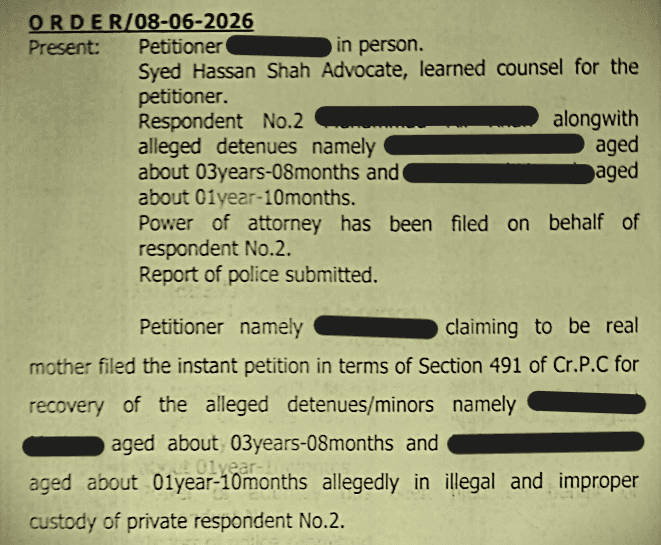
Child Custody Success Under Section 491 Cr.P.C.: Mother Reunited with Children
Legal Insight

Child Custody Success Under Section 491 Cr.P.C.: Mother Reunited with Children

Mother vs State: Mother Secures Custody of Minor Children from Father Under Section 491 Cr.P.C. Case Study | Child Custody & Recovery of Minors | Section 491 Cr.P.C. A recent child-custody matter handled by Advocate Hassan Shah resulted in the recovery and handover of minor children to their mother within three days through proceedings under Section 491 of the Code of Criminal Procedure (Cr.P.C.) . The case involved a mother seeking urgent judicial intervention after being separated from her minor children and seeking their recovery from the father's custody. Case outcome: The mother obtained custody of her minor children within three days of pursuing the proceedings. Case at a Glance ParticularDetails Matter Recovery and custody of minor children Proceeding Petition under Section 491 Cr.P.C. Applicant Mother Respondent State / concerned parties Custody in dispute Father Outcome Minors handed over to their mother Time taken Three days Represented by Advocate Hassan Shah The Background The mother approached the court after being separated from her minor children. She sought urgent legal intervention for the recovery of the children and requested that the court consider the circumstances surrounding their continued custody with the father. The matter raised an important issue concerning the custody, welfare and circumstances of the minors . Rather than attempting to recover the children through self-help or confrontation, the mother pursued a judicial remedy and sought appropriate orders from the competent court. Legal Proceedings Under Section 491 Cr.P.C. The matter was pursued through a petition under Section 491 Cr.P.C. , seeking judicial intervention concerning the custody and recovery of the minors. In proceedings of this nature, the circumstances surrounding the custody of the children are important. The court may consider the facts presented before it and determine what relief is appropriate according to the applicable law and circumstances of the case. Child-custody matters are ultimately concerned with the welfare and best interests of the minor . The legal framework governing custody and guardianship must therefore be considered alongside the particular facts and circumstances of each case. For a broader explanation of the subject, see our guide on Child Custody in Pakistan: Mother vs Father — How Does the Court Decide? . How the Matter Was Resolved The case was pursued on an urgent basis. The relevant circumstances concerning the mother, father and minor children were presented before the court together with the legal grounds relied upon for the requested relief. Following the proceedings, the matter was resolved within three days , and the minor children were handed over to their mother. The result provided immediate relief to the mother and reunited her with her children. Mother vs State — What the Case Means The matter was titled Mother vs State , reflecting the nature of the proceedings before the court. The outcome should, however, be understood as the result of the specific facts and circumstances of this particular case . A result achieved in one custody matter does not mean that every mother, father or parent will obtain the same outcome in another case. Courts dealing with children consider the circumstances of the minors and the applicable legal principles, with the welfare and best interests of the child remaining an important consideration. If you are trying to understand how courts approach custody between parents, our detailed guide on Child Custody in Pakistan: Mother vs Father provides a useful starting point. Why Prompt Legal Action Can Matter Child-custody disputes can become particularly urgent where a parent is separated from their children or believes that the existing custody arrangement requires immediate judicial intervention. The appropriate legal remedy depends on the facts of the matter. Relevant considerations may include: The age of the minors. The existing custody or guardianship position. Whether any previous court order exists. The circumstances in which the children are being kept. The relationship between the parents. The welfare and best interests of the children. The evidence available to the parties. The applicable law and jurisdiction. Parents should therefore obtain legal advice before deciding which proceeding is appropriate. Advocate Hassan Shah's Role Advocate Hassan Shah represented the mother in the proceedings and pursued the matter on an urgent basis. The case required the presentation of the mother's position, the circumstances concerning the minor children and the legal grounds supporting the requested relief. Through prompt judicial proceedings, the mother obtained custody of her minor children within three days . Related Child Custody & Family Law Guides If you are researching child custody or related family-law issues in Pakistan, these resources may help: Child Custody in Pakistan: Mother vs Father — How Does the Court Decide? — An overview of how custody disputes between parents may be considered. Child Maintenance in Pakistan — Information concerning financial support and maintenance for children. Divorce & Khula in Pakistan — Information about divorce, Khula and related family-law proceedings. Wife Maintenance in Pakistan — Guidance concerning maintenance claims and related Family Court matters. Marriage Registration in Pakistan — Information concerning marriage documentation and registration. Legal Consultation in Pakistan — Seek professional guidance regarding your particular legal circumstances. Child custody is part of the broader family-law framework. Your site's legal reference also identifies child custody alongside family-law matters and emphasizes that custody and guardianship should not be treated as an automatic constitutional entitlement of either parent. What Parents Should Do in an Urgent Custody Matter If you are separated from your child or believe that urgent judicial intervention is required, consider taking the following steps: 1. Document the circumstances Keep relevant documents, previous court orders, correspondence and other evidence concerning the children and the custody dispute. 2. Avoid confrontation Parents should avoid attempting to recover children through confrontation or other unlawful means. 3. Determine the appropriate legal remedy Different custody situations may require different legal proceedings. Section 491 Cr.P.C. may be relevant in certain circumstances, but its suitability depends on the facts and applicable law. 4. Obtain legal advice promptly A lawyer can review the circumstances and determine what legal options may be available. Important Legal Qualification The result described in this case study is specific to the particular matter represented by Advocate Hassan Shah. Obtaining custody within three days is not a guaranteed timeframe for other custody cases. The duration and outcome of a custody or recovery proceeding can depend on the facts, evidence, jurisdiction, existing orders, applicable law and the court's assessment of the matter. The welfare and best interests of the minor remain central considerations in child-custody disputes. Conclusion The Mother vs State matter demonstrates how prompt legal proceedings can provide urgent relief in an appropriate child-custody situation. In this particular case, Advocate Hassan Shah represented the mother in proceedings under Section 491 Cr.P.C., resulting in the minor children being handed over to their mother within three days. If you are facing an urgent child custody, recovery of minors, guardianship or family-law matter in Pakistan , obtaining professional legal advice promptly can help you understand the legal remedies that may be available in your circumstances. Disclaimer: This case study is provided for general informational purposes and does not constitute legal advice. The outcome and duration of every case depend on its specific facts, evidence, applicable law, jurisdiction and the orders of the competent court. Past results do not guarantee similar outcomes in future cases.

From Reading to Action

Legal Questions Rarely EndWhere the Article Does

Articles on family law, divorce, wife maintenance, property disputes and women's rights give you the language. A consultation gives you the next step for your own facts, documents and forum.

Tell us the essentials on WhatsApp or through the form. No lengthy paperwork to start.

Get a confidential consultation covering process, documents and expected timeline.

Receive a clear plan and transparent fee understanding before any work begins.

Matters are handled professionally and discreetly. Client confidentiality, always.

Get Started Today

Timeline

Realistic timeframes explained in your first consultation. No vague promises.

Fees

Clear fee structure before engagement. What you pay and what it covers.